By MAURA CAREY AP Sports Writer
Florida’s Boogie Fland was driving to the basket with 1:10 remaining and a three-point lead over Iowa when Hawkeyes forward Cooper Koch stepped into the lane, swatted at the ball and it sailed out of bounds. Officials ruled it Florida’s ball.
Iowa coach Ben McCollum quickly consulted video coordinator Jace Smith, who checked his iPad and nodded yes — go for it.
“I had a very clear view,” Smith said. “Once I saw it, I felt pretty confident, so it was an instant yes. That was a big moment.”
McCollum challenged the call and won; Fland had touched it last. Iowa took possession and outscored Florida 5-1 in the final minute to oust the defending champion and 1-seeded Gators with a 73-72 win and advance to the Sweet 16 for the first time since 1999.
That the tournament’s biggest thriller so far was set up in part by a coach’s challenge is something that wouldn’t have been possible in years past. This season is the first where coaches are allowed to challenge certain calls by officiating crews. The rule change was approved in June, and eight months later, it’s still an adjustment for even the most experienced staffs.
When used correctly, a challenge can flip a game in seconds. But the Gators already knew that.
A new seat on the bench
Florida’s chances of winning a mid-January game at Vanderbilt were slipping when video coordinator Nolan Crist spotted an on-court tangle. He checked the iPad, sideline discussions commenced and what followed changed the game. Coach Todd Golden’s challenge revealed a hook-and-hold, which led to a seven-point swing and boosted Florida’s win probability by roughly 30%. The Gators went on to beat Vanderbilt by four.
Like Iowa, Florida turned to its video coordinator when challenges were introduced. Crist, like all the others, has seconds to make a recommendation.
NCAA men’s teams get one challenge per game and must have a timeout to use it. If the call is overturned, the timeout is retained and the team gets one other challenge. If the call stands, the timeout is lost and no further challenges are allowed. Challenges aren’t used in the women’s game, but coaches can appeal calls. There is no limit on the number of appeals, but a failed one can cost a team a timeout if available. An unsuccessful appeal without an available timeout results in a technical foul and two free throws and possession for the opponent.
For Florida, when a potentially challenge-worthy play unfolds on the court all eyes turn to Crist.
“When a play happens, and every coach turns around and looks at Nolan, he understands it’s his time to shine and figure out what we need to do,” Golden said.
A similar process is followed at N.C. State, where assistant general manager Patrick Stacy runs the system for the men’s team. Stacy keeps a tablet running next to him – sometimes on the floor next to his bench seat, other times leaning against the scorer’s table – while tracking play calls and lineups during the game.
“On any close play, I don’t wait for the call, I just instantly look down and watch the replay and then start clicking rewind,” Stacy said. “If I hear the call went our direction, I’ll obviously put the iPad down and stop reviewing it. If it didn’t, then my clock of that 10 to 15 seconds has started, and we’ve got to make a decision on if it’s the best option or to challenge or not.”
If it passes his review, all information is presented to N.C. State coach Will Wade for the final decision.
“It’s not just a one-person decision. Usually, you’ll hear from the bench what they think… Then coach will look at it and we kind of come to a consensus,” Stacy said.
A complex dynamic with officials
The introduction of challenges has changed dynamics beyond the bench. Video replays are now inaccessible to officials until the final two minutes of the game, meaning the bench has unseen angles at its disposal.
“It’s very easy for us to get the call right when we’re able to stare at the iPad right after, and these guys don’t have the luxury to do that,” Golden said. “It makes it a little bit of a ‘gotcha’ game, and I think it’s a little unfair for the refs that way.”
Several conferences told The Associated Press they do not track challenges. But in 243 men’s basketball games at home arenas in the Southeastern Conference this season, there were 128 total challenges; 85 were reversed and 43 calls stood, a 2-to-1 ratio.
“It’s a little more accurate in how it’s officiated,” Stacy said. “If you can switch to one or two calls a game to get them right, relative to ones that would be wrong in prior years, it rings truer to what the outcome should be.”
The strategy behind the challenge
As coaches grow more accustomed to challenges, teams are developing strategies to maximize them.
Stacy said teams often buy extra time while deciding whether to challenge by sending a substitute to the scorer’s table. Aside from egregious errors, most staffs save challenges for higher-leverage moments later in games.
McCollum’s staff knows not to pull the trigger unless there’s absolute confidence that the call will be overturned.
“We’ve got a really good video guy, got a really good staff, and so they pay attention to it,” McCollum said. “They know to only challenge if you’re a 100% certain. I don’t want 90%. I want a 100%.”
Were they sure against the Gators with 70 seconds left in the game?
“Yeah, he was 100% sure,” McCollum said. “And I didn’t even look at him. He called out to me. He said, ‘Challenge that one, coach.'”
It’s a strategy that has fared well for the Hawkeyes; 9 of 10 challenges have been overturned in Iowa’s favor this year, according to KenPom.com.
The Gators have had similar success, winning 10 of 12 challenges this season by KenPom.com’s count. Golden credits his staff’s detailed preparation as the key to turning a challenge into an advantage. Those efforts included the creation of a challenge chart specific to in-game scenarios.
“It’s just something that we’re organized on, and I think that’s why we’ve been relatively successful with it,” Golden said. “You’re not going to be perfect, but it has been a huge part of our success.”
And as the Gators learned, a challenge can make or break a season.
—-
AP Sports Writers Aaron Beard, Mark Long and Kristie Rieken contributed to this report.
News
March Madness meets the iPad era: How coaches’ challenges are changing the game
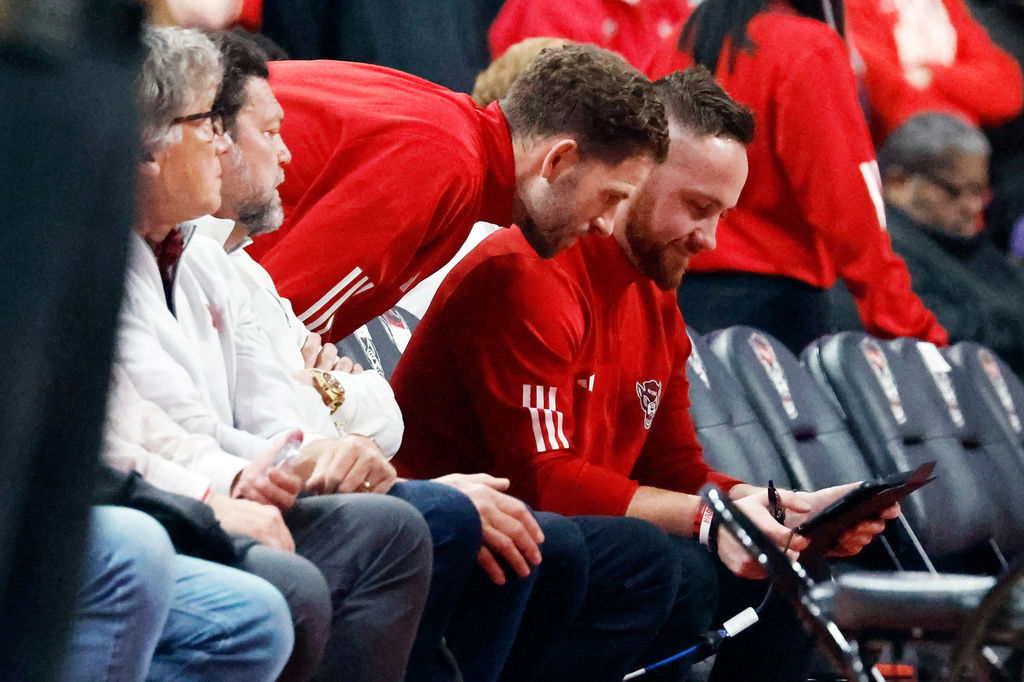
North Carolina States' Reed Vial, left, and Patrick Stacy, center, watch a replay during the first half of an NCAA college basketball game against Duke in Raleigh, N.C., Monday, March 2, 2026. (AP Photo/Karl DeBlaker) Photo: Associated Press