By LAURAN NEERGAARD AP Medical Writer
WASHINGTON (AP) — An experimental drug might help slow early Alzheimer’s disease in a markedly different way than today’s treatments — by lowering levels of a brain protein called tau, researchers reported Tuesday.
Tau is one part of a toxic duo fueling Alzheimer’s but prior attempts to develop drugs that can target the protein have failed. Two Alzheimer’s drugs, lecanemab and donanemab, try to clear buildup of the better-known amyloid protein and can modestly slow cognitive decline.
The new findings suggest Biogen’s diranersen did more than lower tau levels. The study of about 400 people found signs that it also slowed cognitive decline, in one small subset enough to be comparable to amyloid therapy, according to results presented at the Alzheimer’s Association International Conference in London. Biogen is planning a larger study to try to prove the drug’s benefit.
“This is really quite promising if it were to hold up” in that next-step testing, said Jessica Langbaum of the Banner Alzheimer’s Institute in Phoenix, who wasn’t involved with Biogen’s study.
“This is early days,” cautioned Dr. Reisa Sperling of Mass General Brigham, who also wasn’t involved in the study. But “I think it will reinvigorate interest and investment in lots of tau mechanisms, and the field needs that.”
It’s one of multiple novel attempts to fight the mind-destroying disease, including a possible tau vaccine, an experimental heart drug that might do double-duty for some people at high risk of Alzheimer’s, and ways to help medicines more easily get across the so-called blood-brain barrier.
New approaches are needed to fight the leading cause of dementia
It’s not clear exactly what causes Alzheimer’s, which affects more than 7 million Americans and tens of millions worldwide. That sticky amyloid protein starts building up to form plaques in the brain about two decades before symptoms appear. But amyloid alone isn’t enough to cause Alzheimer’s. Many scientists believe that amyloid buildup eventually triggers an abnormal form of tau to form tangles in neurons, setting off symptoms.
Diranersen is what’s called an antisense oligonucleotide that doesn’t attack tau buildup but instead instructs a tau-producing gene to produce less.
“If you lower tau production, you are lowering the amount of the abnormal tau that needs to be cleared by the microglia, by the clearance mechanism in the brain. And so you are enabling the normal clearance mechanism to have more capacity to clear the tau,” said Dr. Cath Mummery of University College London, who led the new study.
Today’s anti-amyloid drugs are given through the bloodstream via infusions or injections. Diranersen is injected into the fluid surrounding the spinal cord, a straighter path to the brain.
Biogen’s tau drug missed a key study goal — but was still encouraging
Biogen’s study included people with mild cognitive impairment or mild Alzheimer’s, randomly assigning them to different doses of diranersen or a placebo. Back in May, Biogen and partner Ionis Pharmaceuticals announced that the lowest dose — given every six months — had the strongest effect. That was a counterintuitive surprise and meant the study didn’t meet its planned goal of showing that higher doses brought greater benefits.
Still, scientists had been anxiously awaiting details about how much that twice-a-year spinal shot really helped. Five of six different brain tests showed diranersen recipients’ memory and other cognitive abilities still worsened but more slowly than those given dummy shots, Mummery said. In one test of the lowest dose, that translated to a 26% reduction in cognitive decline — “approximately the same” change seen in earlier tests of amyloid drugs, she said.
Side effects included injection site pain and a temporary state of confusion that could appear a few days after the shot and last about a week, she said. But there were no signs of brain inflammation, which can affect recipients of anti-amyloid drugs.
Alzheimer’s researchers also target tau in a broad new study
The University of California, San Francisco, last week opened a first-of-its-kind study known as the Alzheimer’s Tau Platform. Funded by the National Institutes of Health, it will test a variety of experimental anti-tau therapies against and in combination with today’s amyloid treatments. First up is a vaccine called AADvac1 designed to train the immune system to recognize and fight a specific worrisome portion of the tau protein, said UCSF’s Dr. Adam Boxer.
The “platform” approach will expand to locations around the country, allow addition of other tau drugs to test and include people with Alzheimer’s-related protein buildup who aren’t yet showing symptoms, he said.
Other studies hint at new ways of attacking Alzheimer’s
Researchers told the Alzheimer’s meeting that an experimental cholesterol-lowering drug called obicetrapib might do more than help heart health. They’re exploring if it also might lower buildup of Alzheimer’s-related proteins in people who carry a genetic risk for the disease.
Why? That gene, called APOE4, also affects how the body processes cholesterol. Obicetrapib maker NewAmsterdam Pharma plans to begin a study soon to test if the drug’s cholesterol effects also can mitigate the Alzheimer’s risk in people carrying one or two copies of that gene.
Companies also are trying to get Alzheimer’s drugs into the brain faster and at higher volumes, by penetrating the protective lining meant to protect the brain from harm. Denali Therapeutics’ CEO Ryan Watts describes it as “hitching a ride” with iron that naturally gets into the brain. His company is pursuing drugs that target tau and amyloid using that “transport vehicle” technology.
___
The Associated Press Health and Science Department receives support from the Howard Hughes Medical Institute’s Department of Science Education and the Robert Wood Johnson Foundation. The AP is solely responsible for all content.
News
An experimental Alzheimer’s drug shows some promise as researchers hunt new approaches
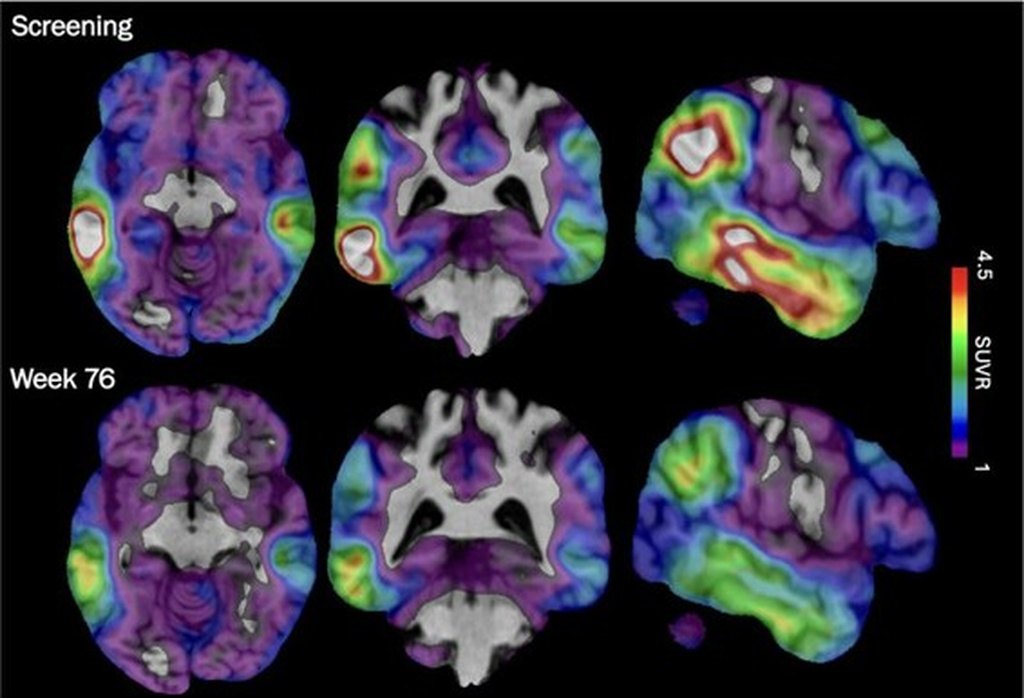
These brain scan images provided by Biogen show how high levels of Alzheimer's-related tau protein, in red, dropped in a recipient of the company's experimental drug diranersen. (Biogen via AP) Photo: Associated Press